QSIP – Empowering Sweden´s Quantum Innovation Future.
|
|
|
|
Quantum Sweden Innovation
Intelligence Digest (QSIID) is a curated monthly newsletter with external
quantum innovation business news from around the globe. |
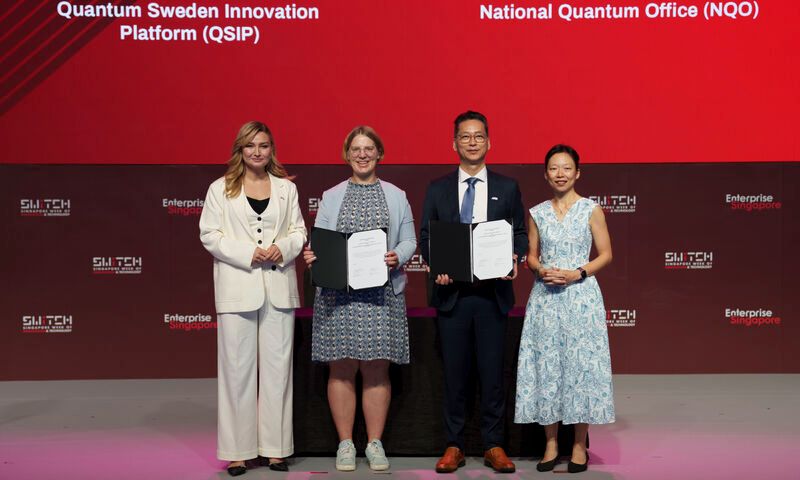
Sweden and Singapore are deepening
their partnership in quantum technology through a newly signed Memorandum of
Understanding (MoU), which was signed in Singapore by Mr. Ling Keok Tong, NQO,
and Dr. Camilla Johansson, QSIP (led by Chalmers Industriteknik). This
agreement brings together leading universities, research institutes, and
national initiatives from both countries, with the shared goal of fostering
long-term collaboration in research, innovation, and industrial applications of
quantum technologies - an area of strategic importance for the future of
foundational technologies.
|
Since its launch
in July, EIFO and the Novo Nordisk Foundation have been working diligently to
find the right CEO for the new Nordic quantum initiative, QuNorth. The
appointment has gone to Swedish national Ebba Carbonnier, who will take up the
role on November 1. As CEO, she will lead the development and operation of the
world’s most powerful quantum computer, Magne, providing Nordic researchers and
companies with access to cutting-edge technology.
| |
Ebba Carbonnier
previously served as Director of the Swedish Quantum Life Science Centre at
Karolinska Institutet, developing Quantum Life Science applications. She
co-authored Sweden’s official quantum strategy and founded the Nordic Quantum
Life Science Roundtable in 2021, an annual conference and a network of
researchers, industry leaders, and funding partners aimed at fostering
collaboration, innovation and use cases in quantum technology. She also brings
14 years of experience as a management consultant, having worked with companies
including Microsoft, AstraZeneca, and Ericsson.
| | | |
The Royal Swedish Academy of
Sciences has awarded the Nobel Prize in Physics 2025 to John Clark of
University of California Berkeley, Michel H. Devoret from both Yale University
and University of California Santa Barbara, and John M. Martinis of the
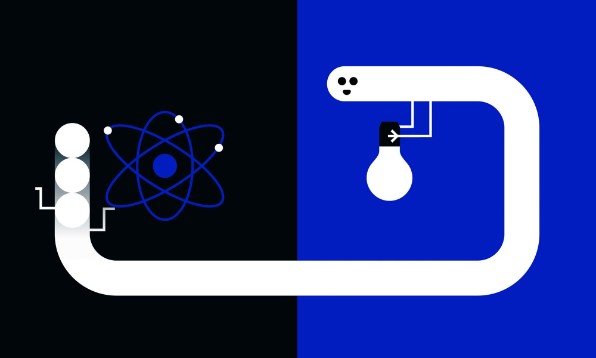
University of California Santa Barbara. A major question in physics is the maximum size of a system that can
demonstrate quantum mechanical effects. The laureates’
experiments on a chip demonstrated that quantum mechanical properties can be
made concrete on a macroscopic scale, demonstrating both quantum
mechanical tunnelling and quantised energy levels in a system big enough to be
held in the hand.
Illustration: ©Johan Jarnestad/The Royal Swedish Academy of Sciences
| |
IonQ and D-Wave, two U.S. quantum computing firms, have joined as
founding members of Q-Alliance, a new initiative in Lombardy aiming to become
“the world’s most powerful quantum hub.”
Launched in Como with government backing, the alliance seeks to
advance quantum research and industrial use as part of Italy’s digital
transformation. Supported by the Interministerial Committee for Digital
Transition and Undersecretary Alessio Butti, Q-Alliance will connect
universities, researchers, and industry. It will also train young scientists,
foster cross-disciplinary collaboration, and help establish Italy as a European
leader in quantum technology.
| | | |
EARTO, the organisation of the European Research and Technology
Organisations, awarded SemiQon and VTT first prize in the “Impact Expected”
category on 14 October 2025 in Brussels for a pioneering cryogenic CMOS
(complementary metal-oxide semiconductor) chip innovation. The solution enables
the full capacity of advanced CMOS functionalities at cryogenic temperatures,
thereby unlocking new possibilities for quantum computing and space
applications.
| |
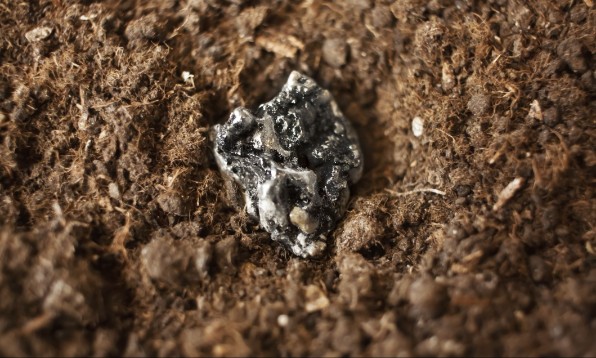
China has tightened its restrictions on rare earth mineral exports, requiring
export licenses for technologies and products related to rare earths, which are
essential for many advanced technologies including quantum computers. Rare
elements such as ytterbium, erbium, europium, neodymium and yttrium form the
hidden foundation of quantum technologies, enabling qubits, quantum memories,
and photonic connections. Controlling about 70% of global rare-earth mining and
90% of refining capacity China dominates the global supply chain, making Western
economies far too dependent and behind in diversifying their processing streams.
| | | |
IBM has launched Guardium Cryptography Manager, an AI-powered system designed to help enterprises secure data and
manage encryption as the era of quantum computing draws closer. The new
solution addresses a growing concern in cybersecurity that future quantum
machines could break the cryptographic protections that secure most of today’s
digital information. According to Vishal Kamat, vice
president of IBM data security, organizations face a dual challenge. Sensitive
data now sprawls across hybrid and multi-cloud environments, expanding the
attack surface, while the eventual arrival of quantum computers threatens to
render much of current encryption obsolete.
| |
Atlantic Quantum, a team of quantum experts from MIT and Chalmers
University, has announced that they have officially joined Google Quantum AI to
“build quantum computing for otherwise unsolvable problems”.
Atlantic Quantum emerged from cutting-edge research conducted at the Department of Microtechnology and Nanoscience and the Wallenberg Centre for Quantum Technology (WACQT) at Chalmers University of Technology, in collaboration with the Massachusetts Institute of Technology (MIT). The company was officially spun out from Will Oliver’s Engineering Quantum Systems Group at MIT in 2022, with the mission to build a scalable quantum computer capable of solving real-world problems.
| | | |
ConScience has been recognized as a DI Gasell 2025, an honor for Sweden's
swiftest-growing enterprises, designated by Dagens Industri's esteemed Gasell
survey. Achieving this status is a privilege bestowed upon less than 1% of
Swedish limited firms. The award is based on robust, sustainable, and organic
growth with healthy profits over the last four years. To be a Gasell, a company
must surpass SEK 10 million in sales, employ at least 10 people, double its
revenue in four years, and maintain organic growth with positive financials.
|
Wave Function Ventures is excited to announce the
final close of its $15M Fund I. Wave Function was created to partner with deep
tech founders building hardware solutions to the world’s most important
problems. energy, robotics, and infrastructure and partners with founders at
the earliest stages. In some cases, Wave Function will invest
pre-incorporation, where Jamie can help founders shape rough ideas into
compelling product plans and visions. Fund I has already made nine investments
spanning those sectors, and the portfolio has shown strong traction, including
multiple follow-on investments from top-tier firms.
| |
55 North, the world’s largest dedicated quantum technology
venture capital fund, today announced the first close of its €300m inaugural
Fund I at €134 million, establishing its position as the sector’s
largest pure-play quantum VC. Headquartered in Denmark, 55 North will be
investing stage-agnostically across the globe, and has already executed two
investments, backing European quantum leader IQM in the company’s
latest €275m Series B, and co-leading the investment in Kiutra’s €13m Series
A-2.
| | | |
The European Space agency’s
(ESA) Security And cryptoGrAphic (SAGA) mission has entered the system
definition and preliminary design phase (Phase B2), marking the beginning of
the development of the first quantum key sharing mission designed for European
governments. A world leading aerospace consortium led by Thales Alenia Spacehas
won a €50 million contract to design the mission. The aim of the mission is to
design, develop and demonstrate how space-based quantum key distribution (QKD)
services can bring a new level of security for Europe.
| |
IonQ announced that it has achieved a record algorithmic qubit score of
#AQ 64. This milestone was achieved on an IonQ Tempo system, three months ahead
of schedule, establishing IonQ as the only company to reach #AQ 64 setting a
new standard for quantum systems. #AQ benchmarks measure a quantum system’s ability to run
quantum algorithms of increasing complexity and size while maintaining high
fidelity.
| | | |
Imec, a world-leading research and innovation hub in
nanoelectronics and digital technologies, and Diraq, a pioneer of silicon-based
quantum computing, have demonstrated that industrially made silicon quantum dot
qubits consistently show error rates that surpass the values needed for quantum
error correction. The results, reported in Nature, show that Diraq’s qubits can be manufactured reliably with
the tools of the silicon microchip trade, confirming the potential of imec’s
industrial manufacturing techniques for developing large-scale silicon-based
quantum computers.
| | | |
Quantum for Everyone
Following the successful launch of
the National Quantum Course in The Hague on World Quantum Day last year, the
next major step in bringing quantum technology closer to the public is already
underway in this UN International Year of Quantum Science and Technology.
On July 11, the International Quantum Course - an initiative
designed to make quantum knowledge accessible to anyone, anywhere in the world
- was launched at the closing ceremony of ITU’s AI for Good Summit in Geneva. Funded
by Quantum Delta NL and developed by a team of experts led by Jim Stolze and
launched together with UNICC and ITU, the International Quantum Course is a
free online program, that unveils the complexities of quantum mechanics,
highlights current developments in quantum technology, and explores its future
implications. The course is currently available in Dutch, English and German,
with more languages expected in the future. | QSIP – Empowering Sweden´s Quantum Innovation Future | | | | | | | | | |
More About Us
Quantum Sweden Innovation Platform (QSIP) is a Swedish initiative to stimulate, foster, and promote quantum technology innovation to support the emergence and growth of a Swedish, globally competitive and attractive industry within and by means of quantum technology.
The platform will provide both individual and general support activities to enable increased innovation, application development and commercialization of quantum technology.
|
This newsletter is produced by QSIP – Quantum Sweden Innovation Platform. QSIP is hosted by Chalmers Industriteknik.
You have recieved this newsletter because you have interacted with QSIP. If you no longer wish to receive our emails, you can [unsubscribe here] at any time.
|
| | |
|
|